Modernizing Documentation at Cloud Scale
In the world of high-performance distributed systems, documentation is more than just a manual. Instead, the docs serve as a critical component of the user’s infrastructure. During my tenure as a Senior Technical Writer at MinIO, I transitioned from being a content creator to a “Documentation Architect.”
My GitHub contributions reflect the level of work:
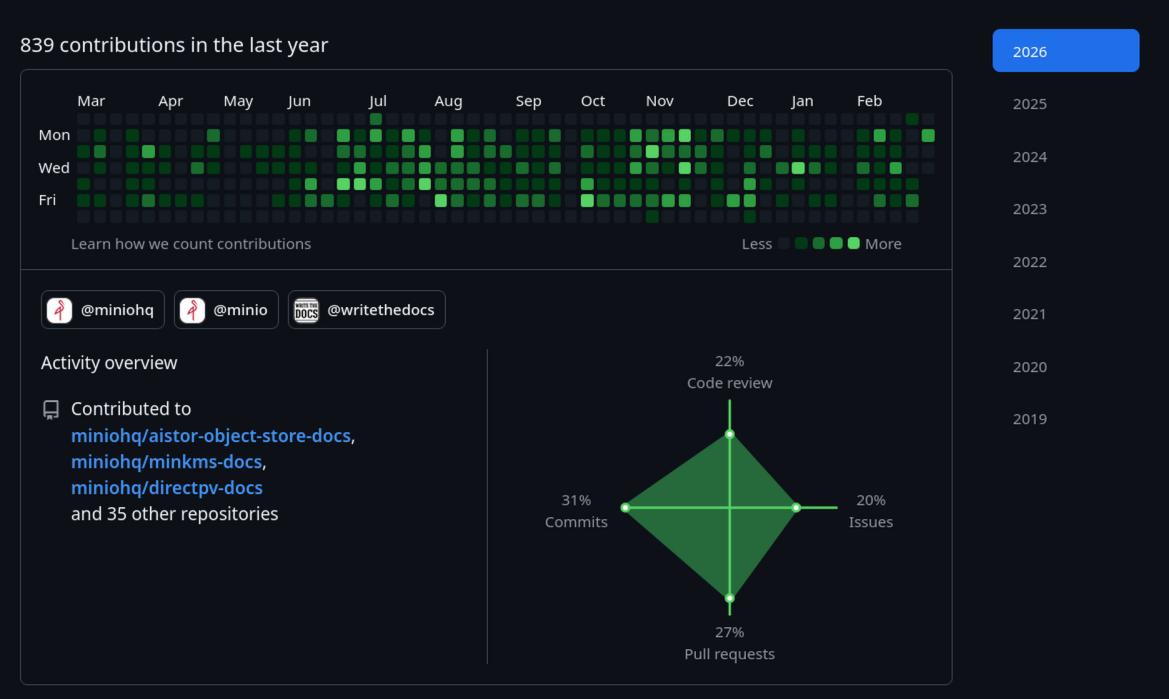
My GitHub metric contributions for the year leading up to February 2026.
My mission was clear: move beyond static, manual pages and build a scalable, automated, and developer-centric documentation ecosystem.
My Writing at MinIO
Here is a look at the strategy and the “Golden Path” onboarding I developed for one of the world’s leading object storage platforms.
The Migration to Docs-as-Code
When I joined, our documentation lived in a legacy Sphinx environment that struggled to keep pace with our rapid release cycles. I led the effort to test-drive MinIO with one of the associated MinIO product, MinKMS, as a test run of using Hugo (developed in Go) for the documentation instead. After a successful pilot with that and a few other associated products, the team embarked on a strategic migration of over 700 technical assets of the main product docs to a Hugo-based framework.
By treating documentation with the same rigor as our Go-based codebase, we achieved:
- 75% faster build times, enabling near-instant previews for our team.
- Version-controlled workflows on GitHub, allowing for seamless parity between software releases and documentation updates.
- Unified UX across five distinct product sites.
See the results of our work yourself:
- MinIO AIStor Documentation as it was on February 28, 2026.
- MinIO Key Management Service was the test run for Docs-as-Code migration.
- MinIO DirectPV documentation was the first set of product documentation I wrote entirely in Hugo.
Architecting the “Golden Path” Onboarding
For a platform engineer, the most important metric is “Time to Hello World.” I redesigned our onboarding journeys to eliminate friction, specifically for Kubernetes-native deployments. By applying elements of the Diátaxis framework, we separated high-level conceptual explanations from hands-on tutorials, ensuring developers could find exactly what they needed in seconds.
I frequently dove directly into Go source code and pull requests to document new features, ensuring our reference material was technically grounded and required minimal hand-holding from the engineering team.
- The upgrade AIStor docs needed to complement the same topographies and methodologies we used for the installation guides. I rewrote and split these to make them easier to navigate to exactly the right tutorial that contained only what the reader in that specific scenario needed.
- Node maintenance is a necessary component of any object store’s operational workflow. After the engineers added the ability to cordon and uncordon AIStor nodes,I wrote this doc to provide a clear, step-by-step guide for maintaining nodes in an AIStor cluster.
Integrating AI and LLM Workflows
Efficiency at scale requires automation. I pioneered the implementation of Claude Code and custom AI-driven workflows into our documentation pipeline. From reviewing upstream releases to diving into the software code to understand the nuances of a specific documentation issue, Claude Code helped us automate structural validation and review processes. This wasn’t about merely generating text, which often required high degrees of human editing.
By using AI to audit our content against our style guides and technical specs, we reduced PR review-readiness latency by an average of three days, allowing our small team to support a Global Fortune 500 customer base with precision.
Technical Reference
Documenting S3-compatible storage requires a deep understanding of APIs and networking. I managed the lifecycle of our technical reference material, ensuring that our API and SDK documentation provided the clarity needed for complex system integrations.
- AIStor Operator reference utilizes a lot of automation to retrieve examples and YAML configurations from the upstream repository.
- Object deletion is a regular occurrence to clean up stale objects, reduce resource consumption, and maintain data integrity. The details of how AIStor handles object deletion used to be scattered across multiple documentation pages. I consolidated this information into a single, easy-to-understand page.
Reflection
The role of the modern technical writer is shifting. We are no longer just writers, we are the bridge between the engineering intent and the user’s success. At MinIO, I proved that by owning the outcome and not just the task, we could create a documentation experience that is as robust and reliable as the code it describes.